
Get your quote: info@losjurados.co.uk

Sprawdź koszty tłumaczenia
Bez żadnych zobowiązań sprawdź koszt tłumaczenia przysięgłego dokumentów
Klikając przycisk 'Wyślij', akceptuję, że moje dane będą przetwarzane w sposób poufny, nie będą udostępniane osobom trzecim i zostaną wykorzystane wyłącznie w celu przedstawienia mi oferty cenowej
Certified Translation in London
If you need an official certified translation in London, we provide fast and fully compliant translations accepted by:
- UKVI (Home Office)
- All UK courts
- Universities & professional bodies
- Solicitors, notaries & immigration advisors
Our certified translations include:
✔ Official letterhead
✔ Translator’s declaration
✔ Signature & certification stamp
✔ Contact details for verification
✔ Digital + optional printed copy
We specialise exclusively in official and immigration-related translations, supporting thousands of clients every year.
✔ Translator’s declaration
✔ Signature & certification stamp
✔ Contact details for verification
✔ Digital + optional printed copy
We specialise exclusively in official and immigration-related translations, supporting thousands of clients every year.
⚡ Same-Day & 24-Hour Certified Translations
We understand that immigration and legal deadlines are stressful.
That is why we offer:
That is why we offer:
- Same-day translations (subject to document volume)
- Express 24-hour service
- Weekend processing on request
🌍 All Languages — One Trusted Team
We translate from 150+ languages, including:
Spanish, Russian, Polish, Ukrainian, Chinese, Arabic, Punjabi, Urdu, Turkish, Romanian, Lithuanian, Latvian, Portuguese, Italian, French, and many more.
All translations are completed by qualified specialists with experience in official UK documentation
Spanish, Russian, Polish, Ukrainian, Chinese, Arabic, Punjabi, Urdu, Turkish, Romanian, Lithuanian, Latvian, Portuguese, Italian, French, and many more.
All translations are completed by qualified specialists with experience in official UK documentation
✔ What Our Certified Translation Includes
Every translation is issued with:
- A signed translator’s declaration confirming accuracy
- Full compliance with UKVI guidelines
- Certification stamp
- Digital PDF (valid for online submission)
- Optional hard copy posted within the UK
Documents We Translate
We regularly prepare certified translations for:
Personal & Immigration Documents
Personal & Immigration Documents
- Birth, marriage, divorce certificates
- Passports & IDs
- Residence, visa & immigration documentation
- Bank statements, payslips, employer letters
- Police clearance & criminal record checks
- Court documents
- Contracts & notarial acts
- Company documents
- Academic degrees, transcripts & certificates
Why Clients in London Trust Los Jurados UK
Your documents are handled with strict confidentiality.
- Experience since 2009 in official translationsWe have been specialising in official and immigration translations for more than 15 years. We know UKVI, Home Office and UK court requirements in detail, ensuring your documents are accepted without delays or corrections.
- Trusted by solicitors, OISC advisors and immigration firmsUK solicitors, OISC-licensed advisors and immigration practices rely on our accuracy, confidentiality and full compliance with formal certification standards.
- Transparent pricing with no hidden feesyou always receive a written quote before we start. No extra charges for stamps, signatures, PDFs or “unexpected” additions — just clear, honest pricing.
- 1,750+ positive reviews across our European officesOur group has more than 1,750 verified Google reviews — clients consistently value our speed, precision and high-quality customer service.
- Dedicated support before, during and after translationWe support you at every stage: clarifying requirements, checking document accuracy, answering questions after delivery and ensuring your translation fully meets its purpose.
What Our Clients Say
Thousands of clients across the UK and Europe trust us with their official and immigration documents. We are proud to maintain one of the highest customer satisfaction ratings in the industry.
Our clients consistently highlight our speed, accuracy, and professional support throughout the entire process — especially when dealing with tight UKVI or Home Office deadlines.
Your experience matters. We are committed to delivering translations you can confidently submit to any UK authority.
Our clients consistently highlight our speed, accuracy, and professional support throughout the entire process — especially when dealing with tight UKVI or Home Office deadlines.
Your experience matters. We are committed to delivering translations you can confidently submit to any UK authority.


Contact us
+44 7350 228 308
info@losjurados.co.uk
info@losjurados.co.uk
71–75 Shelton Street,
Covent Garden, London,
WC2H 9JQ, United Kingdom
Covent Garden, London,
WC2H 9JQ, United Kingdom
FAQ – certified translations in London
Below you will find the most common questions our clients ask when preparing documents for UKVI, the Home Office, UK courts and other British institutions. This section explains how certified translations work in the UK, whether digital copies are accepted, how pricing is calculated and what to do if your original document contains errors.

Yes. All our certified translations fully meet the requirements of UKVI, the Home Office, UK courts, universities and all official bodies in the United Kingdom.
Each translation includes:
Each translation includes:
- A signed translator’s declaration confirming accuracy
- Our official certification stamp
- Company letterhead with full contact details
- The exact wording required by UK authorities
- A digital PDF version accepted for online submissions
No — you do not need to bring originals.
A clear scan or photo of your document is sufficient in almost all cases. This is accepted by UKVI, solicitors and UK courts for certified translations.
However, if an authority specifically requires a translation made from the physical original (rare), we will let you know in advance. For 99% of documents, a digital copy is perfectly fine.
A clear scan or photo of your document is sufficient in almost all cases. This is accepted by UKVI, solicitors and UK courts for certified translations.
However, if an authority specifically requires a translation made from the physical original (rare), we will let you know in advance. For 99% of documents, a digital copy is perfectly fine.
Yes. A digital certified PDF with our signature and certification stamp is fully valid for:
- UKVI online applications
- Home Office uploads
- University admissions
- Online legal submissions
- Digital document portals (e.g., Sopra Steria, TLS, gov.uk)
Pricing depends on three factors:
- Document type
- Standard civil documents (birth certificate, marriage certificate, criminal record, academic certificate) have fixed prices.
- Legal or multi-page documents are priced by volume.
- Language combination
- Common languages (Spanish, Polish, Russian, Ukrainian, Italian) cost less; rare languages (e.g., Punjabi, Urdu, Chinese) may vary.
- Deadline / urgency
- Same-day translations have a small express fee, while 24-hour or standard delivery is often included.
If your original document contains errors (misspellings, incorrect dates, typing mistakes), we can translate it exactly as written, maintaining accuracy for certification.
If the mistake may cause problems in your application, we will:
If the mistake may cause problems in your application, we will:
- Flag the issue to you before translation
- Offer options (annotation, translator’s note, or translation with explanation if allowed)
- Coordinate with your solicitor or advisor if clarification is required
In the United Kingdom, certified translations and sworn translations are not the same — and the distinction is important.
Certified translation (UK standard)
A certified translation in the UK is a translation accompanied by:
It is the standard form of official translation used in the UK.
Sworn translation (used in some EU countries, not in the UK)
A sworn translation refers to a system used in countries like Spain, Poland, Italy, France and others, where translators are officially appointed by the government and have legal authority to “swear” a translation as legally equivalent to the original.
The UK does not operate a sworn translator system.
Instead, UK authorities require certified translations, not sworn ones.
Which one do you need?
If your document is being submitted within the UK, you almost always need a certified translation, not a sworn one.
If your document is going to a foreign country that requires a sworn translation (e.g., Spain), we can arrange this as well through our network of government-appointed sworn translators in Europe.
Certified translation (UK standard)
A certified translation in the UK is a translation accompanied by:
- A signed translator’s declaration
- Certification wording confirming accuracy
- A stamp and official letterhead
- Full contact details of the translation provider
It is the standard form of official translation used in the UK.
Sworn translation (used in some EU countries, not in the UK)
A sworn translation refers to a system used in countries like Spain, Poland, Italy, France and others, where translators are officially appointed by the government and have legal authority to “swear” a translation as legally equivalent to the original.
The UK does not operate a sworn translator system.
Instead, UK authorities require certified translations, not sworn ones.
Which one do you need?
If your document is being submitted within the UK, you almost always need a certified translation, not a sworn one.
If your document is going to a foreign country that requires a sworn translation (e.g., Spain), we can arrange this as well through our network of government-appointed sworn translators in Europe.
In most cases, no.
For the majority of immigration, legal and administrative procedures in the UK, a standard certified translation is fully sufficient and does not require notarisation or an apostille.
When notarisation is not required
UKVI, the Home Office and most UK courts accept translations that include:
When notarisation may be required
A notary certification may be needed if:
When an apostille is required
An apostille is never applied to the translation itself — only to the original document.
If your original document needs legalisation for use abroad, it must be apostilled before translation.
Examples: birth certificates, marriage certificates, police clearances for Spain, Italy, France, etc.
If you’re unsure
Send us the document or the institution’s instructions — we will confirm whether a standard certified translation is enough or whether notarisation/apostille is required.
For the majority of immigration, legal and administrative procedures in the UK, a standard certified translation is fully sufficient and does not require notarisation or an apostille.
When notarisation is not required
UKVI, the Home Office and most UK courts accept translations that include:
- A signed translator’s declaration
- Certification stamp
- Company letterhead
- Contact details of the translation provider
When notarisation may be required
A notary certification may be needed if:
- The receiving institution explicitly requests a notarised translation
- The document is being used abroad (outside the UK)
- A solicitor or court requires a formal verification of the translator’s identity
When an apostille is required
An apostille is never applied to the translation itself — only to the original document.
If your original document needs legalisation for use abroad, it must be apostilled before translation.
Examples: birth certificates, marriage certificates, police clearances for Spain, Italy, France, etc.
If you’re unsure
Send us the document or the institution’s instructions — we will confirm whether a standard certified translation is enough or whether notarisation/apostille is required.
No. UKVI and the Home Office do not accept self-translations — even if you are fluent in English or a professional translator yourself.
For immigration, legal and official purposes, translations must:
Why self-translations are rejected
UK authorities require translations to be independent and verifiable. If a document is translated by the applicant, it cannot be objectively reviewed or validated, which is why UKVI automatically considers such translations invalid.
If your document is simple
Even for short or straightforward documents (birth certificates, bank statements, marriage certificates), a formal certified translation is still required.
For immigration, legal and official purposes, translations must:
- Be completed by an independent, qualified translator or translation company
- Include a signed certification statement confirming accuracy
- Contain contact details of the translator or agency
- Be issued on official letterhead with a certification stamp
Why self-translations are rejected
UK authorities require translations to be independent and verifiable. If a document is translated by the applicant, it cannot be objectively reviewed or validated, which is why UKVI automatically considers such translations invalid.
If your document is simple
Even for short or straightforward documents (birth certificates, bank statements, marriage certificates), a formal certified translation is still required.
Skip the forms — get an instant quote via WhatsApp from your personal manager.
More information about certified translation and the process
Understanding Certified Translations in London

What Makes a Translation "Certified" in the UK?
A certified translation in the United Kingdom is more than just an accurate conversion of text from one language to another. It is an official document that carries legal weight and is recognised by British authorities.
Key elements of a certified translation:
Translator's Declaration - Every certified translation must include a signed statement from the translator or translation company confirming that the translation is a true and accurate representation of the original document. This declaration typically reads: "I certify that this is a true and accurate translation of the original document to the best of my knowledge and ability."
Professional Credentials - The translator must provide their full name, qualifications, contact information, and in the case of a company, registration details. This ensures accountability and allows authorities to verify the translation if needed.
Official Letterhead and Stamp - Certified translations are issued on company letterhead (for agencies) or professional letterhead (for individual translators) and include an official certification stamp or seal.
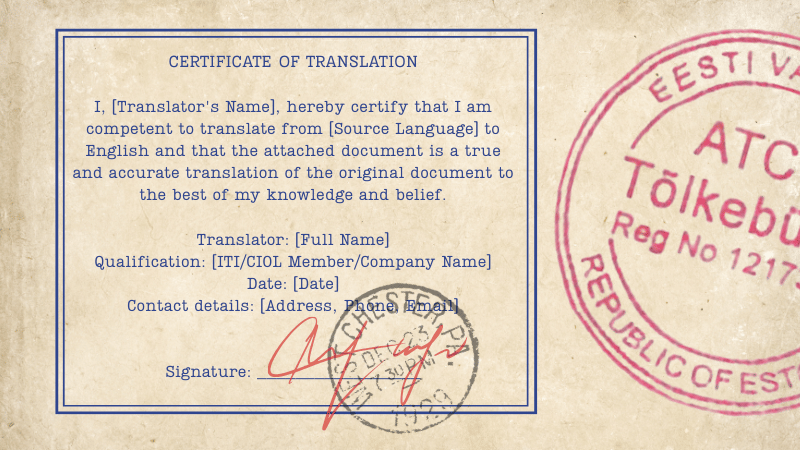
Date and Signature - Each certified translation must be dated and personally signed by the translator responsible for the work.
Unlike some European countries that operate government-appointed sworn translator systems, the UK allows any competent professional translator or translation agency to provide certified translations, provided they meet these formal requirements and take legal responsibility for accuracy.
London's Diverse Translation Needs
As one of the world's most multicultural cities, London has exceptional demand for certified translation services. The capital is home to communities from virtually every corner of the globe, and this diversity creates unique translation requirements across multiple sectors.
Immigration and Settlement - London serves as the primary entry point for thousands of immigrants, refugees, and asylum seekers each year. Whether applying for family reunion visas, spouse visas, work permits, or British citizenship, applicants must provide certified translations of identity documents, birth certificates, marriage certificates, police clearances, and supporting evidence. With processing centres for UKVI applications located in Croydon and other London boroughs, the demand for fast, accurate certified translations remains consistently high.
Legal Sector - London's position as a global legal hub means that solicitors, barristers, and legal firms regularly handle international cases requiring translated evidence, witness statements, contracts, court orders, and legal correspondence. Family law cases involving international custody disputes, divorce proceedings with foreign elements, and probate matters concerning overseas assets all require certified translations accepted by County Courts, Family Courts, and the High Court.
Academic and Professional Qualifications - London's universities, colleges, and professional bodies attract students and qualified professionals from around the world. International students applying to institutions like UCL, Imperial College, King's College London, LSE, and others must provide certified translations of degrees, transcripts, and secondary school certificates. Similarly, healthcare professionals, engineers, teachers, and other regulated professionals must have their foreign qualifications translated and certified for recognition by UK professional bodies.
Business and Financial Services - As a major financial centre, London-based banks, investment firms, and corporate entities frequently require certified translations of company documents, financial statements, contracts, and regulatory filings for international transactions and compliance purposes.
Healthcare Services - NHS trusts across London regularly need certified translations of medical records, prescriptions, vaccination certificates, and patient documentation for non-English speaking patients. This ensures continuity of care and proper medical treatment for London's diverse population.
The combination of these factors makes London the UK's largest market for certified translation services, with thousands of documents processed daily to support immigration, legal, academic, and business activities.